
Makeovers, meltdowns, and moral reckonings: A look back at America's Next Top Model
Wanna be on top?

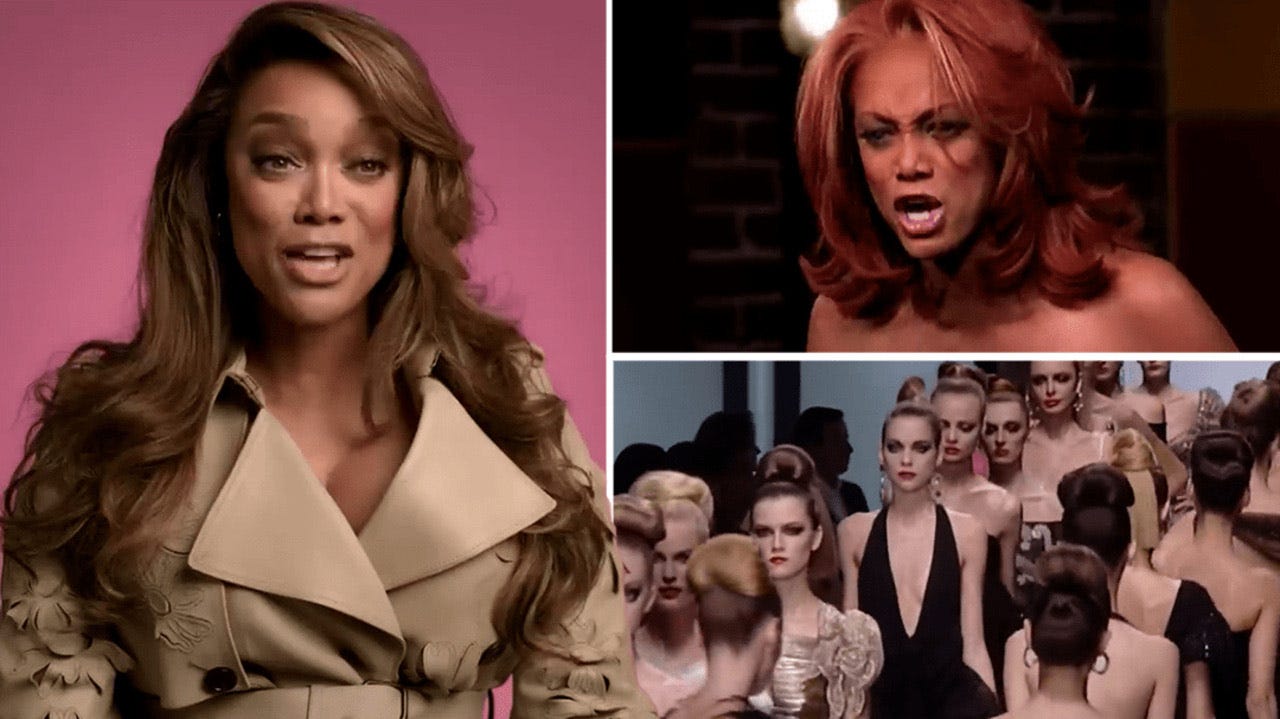
Is there world ready for the very first high profile America’s Next Top Model documentary series? I know I am!
It’s the moment many of us (i.e. pop culture obsessed millennials) have been waiting for: this week Netflix dropped its explosive trailer of “Reality Check: Inside America’s Next Top Model” which comes to the streaming service on February 16th.
In the trailer, iconic clips such as “I was rooting for you! We were all rooting for you!” and arguably the shows most controversial photoshoot - the race-swap - play as Miss Jay, Jay Manuel, Nigel Barker, and past contestants appear, as well as what really is for the first time, Tyra Banks herself is interviewed. “I haven’t really said much” Banks says at the top of the trailer “but now it’s time.”
Which begs the question: why now?
Twenty-three years after the show’s first season (or “cycle” as they were called) hit our screens seems like odd timing. And from the trailer, it’s definitely giving more of an exposé vibe than a commemoration. Perhaps now that more and more of the past contestants are speaking out (whether via book or podcast) the heat is finally getting to Tyra.
Call me naive, but I really do believe that Tyra started this show with good intentions. After years of working as a top model herself, Banks saw first hand how elitist and frankly, how racist, the industry could be. The show was a sincere attempt to give girls from diverse economic and ethnic backgrounds an opportunity to break into the most exclusive industry in the world: high fashion.
One thing you cannot take away from America’s Next Top Model is how truly groundbreaking it was in its representation of women and queer people. Jay Manuel, creative director of the shoots, and Miss Jay Alexander, the runway coach, were two queer men of colour thrust front and centre into the mainstream pop culture zeitgeist. For me watching it as a little gay boy in the middle of nowhere, I was astounded. I had never seen someone like Jay Alexander before in my entire life and I was immediately obsessed. The contestants too came to the show with incredible back stories. I’m reminded of Isis King who was the show’s first transgender contestant back in 2008 (cycle 11) and helped popularise the term “born in the wrong body”. For all its faults, ANTM’s progressive cultural impact is undeniable, not only bringing modern inclusivity to televisions worldwide but also bringing couture to the masses. As well as educating the viewers, some of contestants were differently abled or young single mothers, some lived on a trailer park or in remote places where access to fashion wasn’t just limited - it didn’t exist.
Keep in mind that this was the early 2000s. Facebook was a mere twinkle in Zuckerberg’s eye, let alone Instagram or TikTok. If you wanted to know about fashion - you had to go looking for it. And queer or racial inclusivity on a major TV network? Will & Grace carried!
Tyra’s mission seemed to be simple: let’s show the world that you don’t have to be rich, white, or stick thin to make it in fashion. A girl from a trailer park could genuinely be America’s Next Top Model. Of course over the years, when the millions started rolling in, the show lost sight of its original mission and instead became a reality TV entertainment show, masquerading as a fashion-oriented career launch pad.
A huge part of the show, which viewers and contestants alike looked forward to was the makeover episode. At first the makeover weeks were incredibly humble, a trim, making blonde girls more blonde or making someone a redhead perhaps. Of course, like with everything else on the show, these consistently became more extreme. Girls were given excruciatingly uncomfortable weaves (even white girls I might add) some were shaved bald, burned with peroxide, got clipped with ratty extensions, and even in one especially memorable makeover in cycle 15, contestant Chelsey Hersley had her front tooth gap intentionally widened by a dental surgeon - an increased gap which remains with her to this day. Which seems comical when you consider that Danielle Evans (from cycle 6) had her natural tooth gap permanently closed. But at least Dani went on to win her cycle I suppose.
As a viewer, let’s be honest with ourselves, we liked it when the girls looked good, but we loved it when they cried and freaked out. Tyra wasn’t going to rest until each and every girl looked exactly how she wanted to - one “Mia Farrow in Rosemary’s Baby” hair cut at a time.
“It was very very intense, but you guys were demanding it.” Banks says in the trailer, ostensibly blaming us to viewers for the show reaching its ludicrous heights. In the words of Nene Leakes, now why am I in it?
ANTM sold itself as a Cinderella story but what we really tuned in for was the glass slipper shattering in slow motion. Now, decades later, the mascara-streaked teary confessionals and morally questionable makeovers are back under the spotlight.
Maybe Tyra really did start out wanting to democratise high fashion. Maybe the industry needed a wrecking ball wrapped in false lashes. Two things can be true! In hindsight, ANTM didn’t just reshape modelling; it perfected a template for reality TV cruelty dressed up as opportunity.
Whether the documentary series crowns Tyra as a disruptor, a villain, or something far messier, one thing’s certain: we’re still watching, still quoting, and still immortalising the show with gifs and memes. My Instagram reel expressing my excitement for the documentary series has so far reached over half a million views and in just twelve hours became my most viewed, most liked, and most shared reel on the platform. The appetite for Top Model is clearly still ravenous.
Now, with Netflix cracking open the vault, we’re being asked not just to relive the good, the bad, and the ugly moments, but to interrogate why they thrilled us so much in the first place and ultimately, what exactly does it take to be on top?
https://substack.com/@smizzo/p-186126048